
10 Essential Plyometrics For Hockey Players: Train Smarter, Explode Faster
Unlock Explosive Power: Why Plyometrics Are a Game-Changer for Hockey Players
In the high-octane world of ice hockey, raw strength and endurance are fundamental, but true on-ice dominance often hinges on a player’s ability to generate explosive power and lightning-fast movements. This is where Plyometrics For Hockey Players become a game-changer. These dynamic exercises train your muscles to exert maximum force in short intervals, translating directly to increased skating speed, harder shots, and more agile stickhandling. Integrating plyometric training into an off-ice regimen is not merely an enhancement; it’s a critical component for athletes looking to elevate their performance and gain a decisive edge over the competition. By focusing on rapid, powerful contractions, hockey players can unlock their full athletic potential, transforming their game from powerful to truly explosive.
What Are Plyometrics and How Do They Boost On-Ice Performance?
Plyometrics, often referred to as “jump training,” are exercises designed to improve muscular power and explosiveness. They involve stretching a muscle before it contracts, allowing for a more forceful and rapid contraction, a mechanism known as the stretch-shortening cycle (SSC). This biomechanical principle is at the heart of many on-ice actions, making plyometrics highly specific and beneficial for hockey players.
When performing a hockey stride, for instance, the muscles in the legs undergo a rapid eccentric (lengthening) contraction followed immediately by a powerful concentric (shortening) contraction to propel the skater forward. Plyometric exercises, like box jumps or broad jumps, mimic and intensify this action off-ice. By training the body to transition quickly and powerfully between eccentric and concentric phases, hockey players can experience significant improvements in:
- Acceleration: Exploding off the starting line or reacting quickly to a loose puck.
- Speed: Achieving higher top-end skating speeds.
- Agility: Executing sharp turns, sudden stops, and rapid changes of direction.
- Shot Power: Transferring more force from the lower body and core through the stick to the puck.
Research consistently highlights the positive correlation between plyometric training and on-ice performance. For example, a study examining the effect of a plyometrics program intervention on skating speed in junior hockey players found significant improvements in 40-meter sprint times, demonstrating the direct transfer of off-ice plyometric power to on-ice speed. This ability to generate power quickly and efficiently is fundamental to nearly every movement in hockey, making plyometrics an indispensable tool for athlete development.
The Core Benefits: Agility, Neural Efficiency, and Structural Strength for Hockey
Beyond raw speed, plyometrics offer a multifaceted array of benefits crucial for hockey players:
- Enhanced Agility: Hockey demands constant changes in direction, quick lateral movements, and sharp pivots. Plyometrics specifically train the fast-twitch muscle fibers responsible for these rapid, reactive movements, helping players maintain balance and control even at high speeds. Exercises like lateral bounds directly translate to improved edgework and defensive maneuvers.
- Increased Neural Efficiency: Plyometric training optimizes the communication between the nervous system and muscles. This leads to quicker reaction times, improved coordination, and the ability to recruit more muscle fibers simultaneously for greater power output. This neural adaptation helps players react faster to game situations, whether it’s intercepting a pass or quickly changing direction to beat an opponent.
- Improved Structural Strength and Resilience: The controlled impact and explosive nature of plyometrics strengthen not only muscles but also tendons and ligaments. This increased resilience helps prevent common hockey-related injuries, particularly those affecting the knees, ankles, and hips. Proper plyometric progression gradually builds the body’s capacity to absorb and redirect force, making players more durable throughout a demanding season.
In essence, plyometrics don’t just make players faster; they make them more athletic, adaptable, and robust, ready to withstand the rigorous demands of the game.
10 Essential Plyometrics For Hockey Players: Train Smarter, Explode Faster
To integrate Plyometrics For Hockey Players effectively into your training, focus on exercises that target lower-body explosiveness and mimic on-ice movements. Always perform a thorough warm-up beforehand to prepare your muscles and reduce injury risk.
Here are 10 essential plyometric exercises:
- Jump Squats: Start in a squat position, then explode upwards, jumping as high as possible. Land softly with bent knees and immediately go into the next squat. (3 sets of 10 reps)
- Lateral Bounds (Skater Jumps): Push off one leg and jump sideways, landing on the opposite leg. Immediately jump back in the other direction. Focus on quick, powerful lateral propulsion. (3 sets of 10 reps per leg)
- Broad Jumps: Stand with feet shoulder-width apart, swing your arms back, then explode forward and jump as far as possible. Land softly with bent knees. (3 sets of 10 reps)
- Tuck Jumps: Jump vertically as high as you can, bringing your knees towards your chest at the peak. Land softly and prepare for the next jump. (3 sets of 10 reps)
- Jumping Lunges: Begin in a lunge position. Explode upward, switching your legs mid-air, and land in a lunge with the opposite leg forward. Maintain good balance. (3 sets of 10 reps per leg)
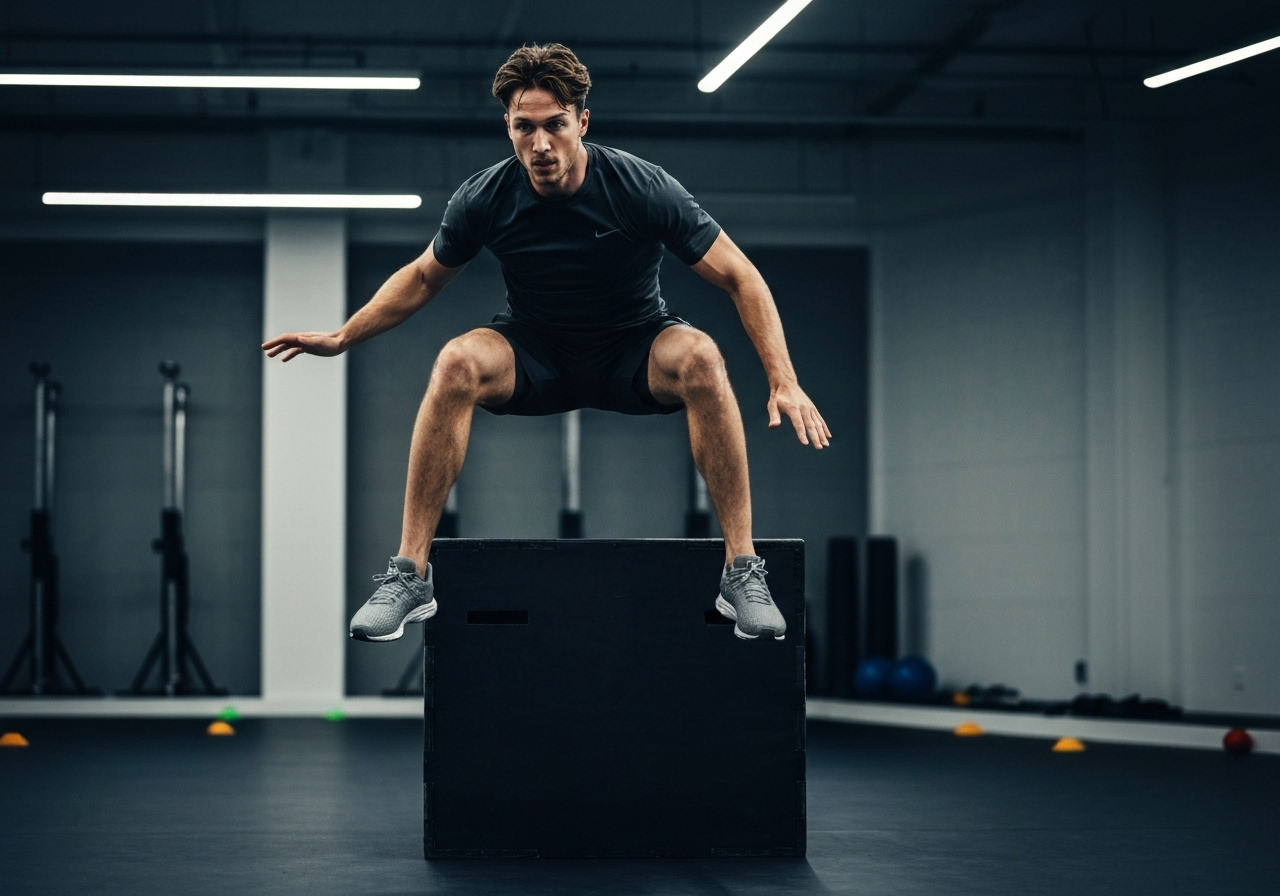
- Box Jumps: Stand in front of a sturdy box (start with a low height). Jump onto the box with both feet, landing softly. Step down and repeat. Focus on controlled landings. (3 sets of 5-8 reps)
- Depth Jumps: Step off a low box, and immediately upon landing, explode into a vertical jump. This emphasizes the stretch-shortening cycle. (3 sets of 5 reps)
- Single-Leg Hops: Hop forward on one leg, focusing on distance and soft landings. This builds unilateral power crucial for skating. (3 sets of 5-8 hops per leg)
- Cone Hops: Place several cones in a line. Jump over each cone laterally, focusing on quick ground contact and explosive pushes. (3 sets of 10-15 cones)
- High Knees (Plyometric Focus): Perform high knees with maximum intensity, focusing on driving your knees explosively towards your chest and minimizing ground contact time. (3 sets of 30 seconds)
For demonstrations and further variations, resources like Fusion Hockey’s plyometric plan and Elite AM Sports’ summer training regimen provide excellent visual guides.
Common Mistakes: Avoid Overuse and Injury in Plyometric Training
While plyometrics offer significant benefits, improper application can lead to overuse injuries and diminished returns. Here are common mistakes to avoid:
- Excessive Volume: Plyometrics are high-intensity by nature. Too many repetitions or sets can quickly lead to fatigue, poor form, and increased injury risk. It’s not about how much you do, but how well.
- Insufficient Rest: Adequate recovery is crucial for muscle repair and neurological adaptation. Performing plyometrics too frequently without sufficient rest (typically 48-72 hours between sessions) can lead to overtraining and plateaus.
- Poor Progression: Jumping into advanced plyometric exercises before mastering foundational strength and proper landing mechanics is a recipe for injury. Progression should be gradual, starting with low-impact drills and gradually increasing height, intensity, and complexity.
- Neglecting Warm-Up and Cool-Down: A comprehensive warm-up prepares the body for explosive movements, while a cool-down aids flexibility and recovery. Skipping these vital steps compromises performance and increases injury susceptibility.
- Incorrect Landing Mechanics: Landing softly with bent knees to absorb impact is paramount. “Stiff” landings put excessive stress on joints and can lead to acute injuries. Focus on controlled deceleration.
As noted by experts, plyometrics can be dangerous and thus should be highly individualized in their exercise selection and volume. Prioritizing correct form and listening to your body are key to safely harnessing the power of plyometric training.
Programming Plyometrics the Right Way: Volume, Frequency, and Progression
Effective plyometric programming balances intensity with adequate recovery to maximize gains while minimizing injury risk. Here’s how to structure it:
- Volume: Given their high-impact nature, plyometrics should always be low-volume. For most hockey players, 4-8 sets of 3-5 jumps per session are generally sufficient, even for advanced athletes. More is not better; quality repetitions are paramount.
- Frequency: Aim for 2-3 plyometric sessions per week. This allows for optimal recovery (48-72 hours) between high-intensity workouts, promoting muscle adaptation and neurological recovery. Avoid daily plyometric training unless prescribed by a specialist as part of a highly individualized program.
- Progression: Start with foundational exercises (e.g., box jumps onto low boxes, broad jumps) focusing on perfect landing mechanics. Once proficiency is achieved, gradually increase difficulty by:
- Increasing jump height (e.g., higher boxes for box jumps).
- Adding complexity (e.g., single-leg jumps, reactive jumps).
- Decreasing ground contact time (for speed and reactivity).
- Incorporating varied directional movements (e.g., lateral bounds, rotational jumps).
It is crucial to integrate plyometrics into a periodized strength and conditioning plan, often in blocks of 4-6 weeks several times per year, rather than continuously year-round. This strategic approach ensures peak performance during crucial phases of training and competition while preventing burnout and injury.
Safety First: Ensuring Proper Form and Athlete Readiness
Safety is paramount in plyometric training. Given the high forces involved, improper technique or insufficient physical readiness can lead to serious injury. Before any plyometric session, ensure the following:
- Master Foundational Strength: Athletes should have a solid strength base. For example, being able to squat 1.5 times their body weight is often cited as a prerequisite for advanced plyometric drills.
- Proper Warm-Up: A dynamic warm-up that includes light cardio, mobility drills, and activation exercises is essential to prepare muscles, tendons, and joints for explosive movements.
- Correct Landing Mechanics: This is arguably the most critical safety factor. Emphasize landing softly with bent knees, absorbing the impact through the hips and ankles, rather than stiff-legged. The landing should be quiet and controlled.
- Appropriate Surfaces: Perform plyometrics on forgiving surfaces like grass, wrestling mats, or specialized plyometric boxes, not hard concrete or asphalt, to minimize joint stress.
- Gradual Progression: Never jump into advanced drills. Start with low-intensity jumps (e.g., squat jumps, pogo hops) and gradually progress to higher impact or more complex movements (e.g., depth jumps from higher boxes, single-leg bounds).
- Supervision and Feedback: Especially for younger athletes or those new to plyometrics, qualified coaching is vital to monitor form, provide immediate feedback, and prevent compensatory movements that lead to injury.
- Adequate Rest: As high-intensity work, plyometrics demand sufficient recovery. Avoid training to exhaustion and ensure full recovery between sets and sessions.
A study on plyometric training in elite hockey players highlights the importance of individualized progression and low-volume protocols, especially when integrated into an already demanding training schedule, to prevent overload and injury. Prioritizing these safety measures ensures that plyometrics remain a powerful tool for performance enhancement rather than a pathway to the sidelines.
Train Differently: Charlotte Hockey Lab’s Approach to Speed and Explosiveness
At Charlotte Hockey Lab, we understand that traditional training methods alone may not be enough to reach elite levels of speed and explosiveness required in modern hockey. Our philosophy embraces a “train differently” approach, integrating cutting-edge technology with scientifically backed methodologies to unlock each player’s full potential.
We recognize that hockey is a game of explosive bursts, quick changes of direction, and powerful movements, all of which are directly supported by effective plyometric training. Our facility is designed to complement on-ice development by providing unparalleled off-ice resources. This includes state-of-the-art technology like:
- RapidShot Systems: Offering immediate feedback on shot speed, accuracy, and reaction time, allowing players to develop explosive shot power.
- Synthetic Skating Treadmills: Providing a controlled environment to refine stride efficiency, develop explosive leg drive, and build anaerobic endurance for sustained bursts of speed.
- Dedicated Shooting Lanes: Allowing for high-volume, targeted shooting practice to translate off-ice power into on-ice scoring ability.
Our approach goes beyond generic workouts. We focus on hockey-specific movements and the kinetic chain involved in skating, shooting, and accelerating. By providing measurable data and repeatable training scenarios within our state-of-the-art facility, we ensure that every repetition contributes directly to improving a player’s speed, agility, and overall explosiveness on the ice. This tailored, data-driven training regimen allows players to transform their raw athletic potential into game-changing performance.
Elevate Your Game: Final Thoughts on Mastering Plyometrics for Hockey
Mastering plyometrics for hockey is a strategic investment in athletic development, offering a clear pathway to enhanced on-ice performance. By consistently applying these explosive training principles, players can cultivate superior speed, agility, and power—attributes that define success in the modern game. The key lies in understanding the science, committing to proper form, and implementing a progressive, well-rested training regimen. Integrating plyometrics effectively means building a body that reacts faster, accelerates harder, and generates more force, ultimately translating into a more dominant presence on the ice. Embrace the challenge of training smarter, and watch your game explode.
Ready to unlock your explosive potential on the ice? Visit Charlotte Hockey Lab’s Contact Us page today to learn how our specialized training can elevate your game!
Related Posts










We use only the finest ingredients to produce stellar tastes.